

Assistants, Not -esses


This is my final specific ‘appeal’ to my brothers to cease using the term “non-commissioned deaconesses.” I intend to continue writing on matters of polity, worship, and church history, including further reflection on this topic. The next two articles will examine the decisions of the northern and southern Presbyterians to amend their BCO to permit female officers.
This article is different from what has come before. I have presented my case clearly and offered charitable arguments that encourage thought and discussion. In this article, I aim to accomplish two simple tasks: first, to express my gratitude to those who have read these articles, and second, to outline what I believe is the most effective solution to this issue.
Thank You
Discussions about topics on which we disagree are rarely enjoyable, but they are an essential part of maintaining relationships. When one person believes another is in error or engaging in an unhelpful practice, and no action is taken, it causes division rather than unity. This false unity is often how we handle conflict. However, resolving conflict is always an active, not passive, process. One can actively choose to overlook a difference, but when the disagreement is substantial, it must be addressed appropriately.
The church needs these kinds of healthy conversations. Writing out one’s thoughts is far more productive than engaging in emotional discussions where flippant words or immature thoughts are spoken without reflection. Or a brief post on social media that fails to communicate clearly. A well-articulated, prayerfully considered response, written with wisdom, can bring clarity to the church. I pray these have been the latter, not the former. We also need these discussions to clarify our own positions. Even as I have written these articles, I am grateful for the opportunity to clarify my own position and recognize how this practice varies across churches; some expressions of it, I believe, need to cease immediately, while others require further clarity.
Thank you for engaging with me online, in discussions, or by other means. Let us continue to discuss and disagree, because in doing so, we may find greater agreement. Where we continue to disagree, we may still find grace and clarity, ensuring that we hold to the best arguments and best practices within our denomination.
Simple Solution
Throughout my articles, I have pointed to what I believe is the solution to this issue: the PCA already has an explicit provision in BCO 9–7, which states:
It is often expedient that the Session of a church should select and appoint godly men and women of the congregation to assist the deacons in caring for the sick, the widows, the orphans, the prisoners, and others who may be in any distress or need. These assistants to the deacons are not officers of the church (BCO 7-2) and, as such, are not subjects for ordination (BCO 17).
Here are five specific areas churches practicing non-ordained commissioned deaconesses should consider discussing and possibly reforming:
1) Select and Appoint
Churches should reconsider the practice of congregational nomination and election for those who assist the Diaconate. When the selection process mirrors or closely resembles the election of deacons, it creates unnecessary confusion. It blurs the distinction between ordained officers and those serving in a non-official capacity. Diaconal assistants are not in an office and hold no ecclesiastical authority; therefore, there is no necessity for their election by the congregation. Many churches do not call associate pastors but only assistant pastors, positions elected by the Session rather than the congregation. If that is the case, why would we have the congregation elect men and women whose role is to assist the diaconate, rather than those who will be assistant Pastors?
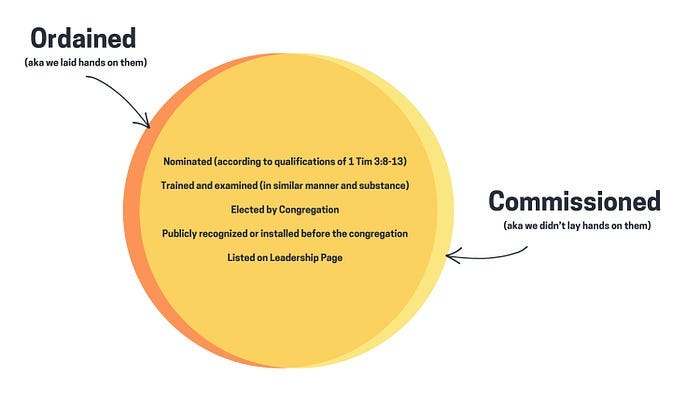
The Session alone should select and appoint diaconal assistants. How a Session solicits suggestions from the congregation about godly members who could assist the diaconate is at the discretion of each Session, while avoiding the same procedure, qualifications, etc. The Session should be intentional in creating distinct categories so that members understand the difference between nominations for officers and suggestions for diaconal assistants. However, most Sessions should already have a clear sense of who in their congregation would make good diaconal assistants simply by observing who is already serving.
2) Godly Men and Women
The Diaconate needs both male and female assistants. If we assume that only women can serve as diaconal assistants, we neglect the contributions of many willing and gifted men. The Book of Church Order affirms that godly men and women, even those not called or qualified for the office of Deacon, can still serve Christ’s church in meaningful ways (Eph 4:12).
Many men and women are eager to serve, and the Session should seek to use their gifts wisely as they assist the Diaconate. The goal is not to create a parallel office but to encourage greater service in the church’s mercy ministry.
3) Lighten the Load
The work of the Diaconate is weighty and weary, and the BCO requires every church to have a Diaconate; if it is impossible to secure deacons, all the weight falls on the ruling elders (BCO 9–2). Many Diaconates could expand their mercy ministry by thinking more intentionally about the categories of people in need within their congregation or broader community. Consider these categories mentioned in the BCO:
The lonely
The friendless
The sick
The widows
The orphans
The prisoners
Any in distress or need
If every Session/Diaconate were to write down the names of individuals in their church who fall into these categories, they would quickly recognize the need for a strong Diaconate and a large army of diaconal assistants.
4) Avoid Confusing Titles or Placement
If you are going to assign godly men and women to serve as diaconal assistants, then use a simple, clear term that members can easily understand and that clearly distinguishes them from ordained Deacons without reference to gender.
Consider terms such as diaconal aides or assistants, deacons’ assistants, mercy ministry assistants, deacon’s helpers, congregational care assistants, servants of mercy, or mercy ministry support team members.
Whatever term is used, it should be clearly distinguished in online listings and bulletins so that a reasonable person would not assume they hold an ordained office. Clear links or quotations from the BCO should be provided for people to know where our church finds its order. In contrast, a lack of clarity in language invites confusion and misunderstanding, and it is wise to avoid anything that suggests ordination where none exists. Also, this term shows their relationship to the Diaconate and Session; they serve as assistants, not as a separate, independent team or board. Web design is critical not only for using the correct titles but also for creating a clear separation throughout the design (Eg, headings, spacing, etc).
5) Ordain Deacons
This point is more of a correction than a suggestion. I hope I have demonstrated care and consideration in presenting my case, and if this comes across as strongly, it is only because I believe we are dealing with a grave error. If your church does not presently ordain deacons, for whatever reason, you must begin to ordain your deacons. You cannot have a diaconate without deacons. Christ has given His Church the office of deacon, and He has appointed officers to serve Christ and His people through that office. Refusing to ordain deacons is, in practice, to say that the Church has only one office: elders. But the BCO does not present the Diaconate as optional or interchangeable. There may be extraordinary circumstances in which a church temporarily lacks deacons (as seen in Titus 1).
The BCO does not grant sessions or congregations discretion to redesign Christ’s government for His Church. Christ has appointed officers, and the Church is called to recognize and ordain them. BCO 9-1; 9-2; 17-1; 24-1; 24-5; and 24-6 clearly establish the office of deacon as ordinary and perpetual, requiring congregational election and ordination by the Session. A church may lack deacons only in extraordinary situations, but must seek to remedy this (BCO 9–2).
Final Thoughts
My plea is not merely about semantics but about the clarity and integrity of the church office in the PCA. I am not writing this to attack fellow believers, but because I believe our words, practices, and church structures matter. I believe Christ has blessed his church with two offices and many godly men to serve as officers.
We already have a clear solution in the BCO that allows men and women to assist the diaconate without creating confusion about ordination. My encouragement is simply this:
Follow the BCO and BCO 9–7 as written.
Use correct Constitutional terminology that clearly distinguishes between ordained officers and assistants.
Encourage and equip both men and women to serve faithfully within biblical parameters.
May our discussions be gracious, thoughtful, and fruitful, as we seek to serve Christ’s church with clarity and faithfulness.
As always, if I have misrepresented, misspoken, or mischaracterized anything, I remain open to correction and discussion.