
Chrysostom and διακονία

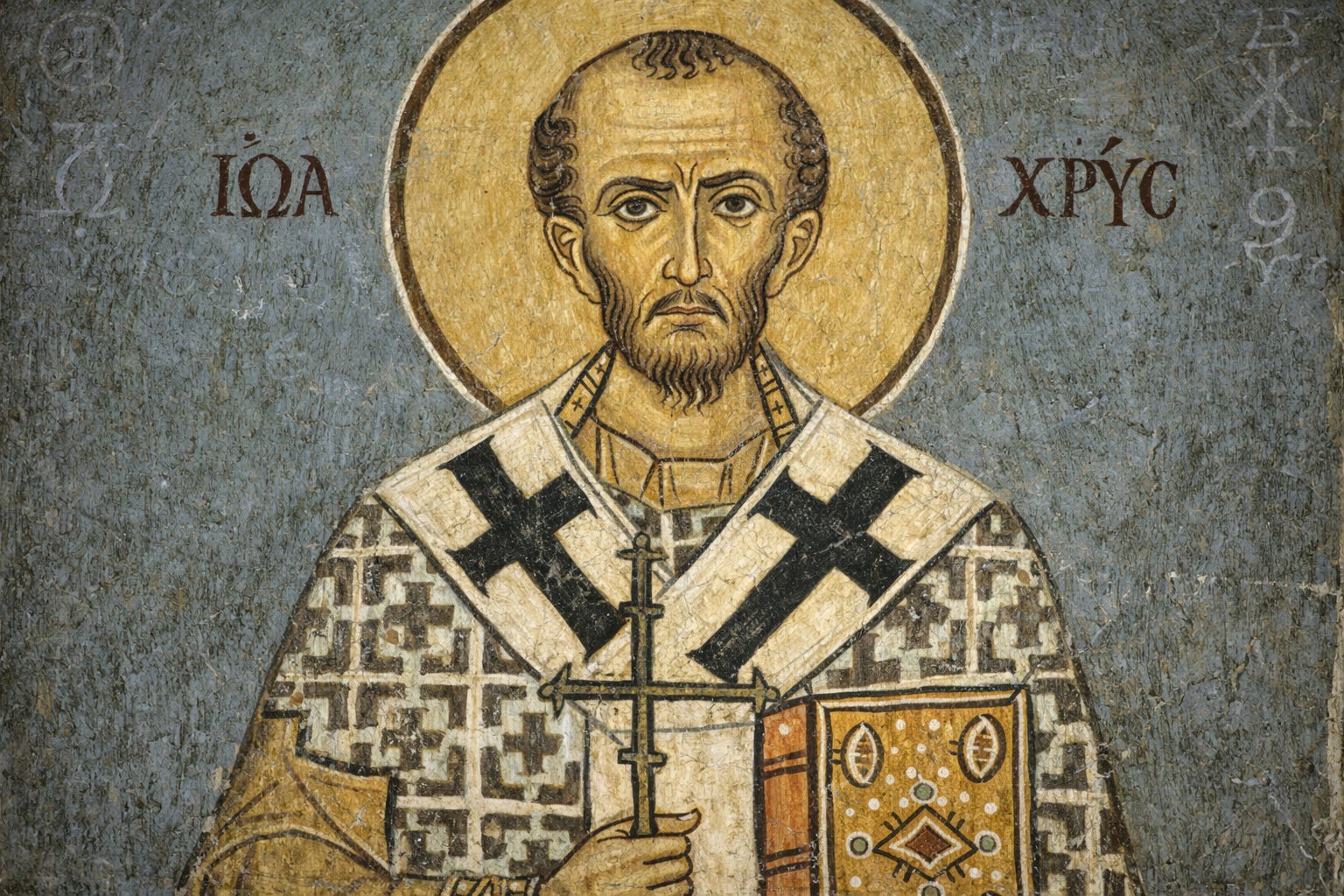
John Chrysostom (c. AD 347–407), whose name means “golden-mouthed,” is remembered as one of the greatest preachers of the early Church. Born in Antioch, he was trained in classical rhetoric before devoting himself to the ministry of the Word. He served first as a presbyter in Antioch and later, reluctantly, as Archbishop of Constantinople, where his uncompromising preaching and passion eventually led to his exile and death.
Chrysostom has left the Church an extensive body of homilies on nearly every major portion of Scripture, especially the Pauline Epistles. These sermons are marked by a clear, text-driven exposition, shaped by the Antiochene tradition, which emphasized the literal sense of Scripture over allegory. His preaching is indeed rich in pastoral warmth and moral application, frequently pressing the doctrinal meaning of a passage into concrete exhortation concerning humility, charity, prayer, and holiness of life. Chrysostom’s interpretations are notable for attention to grammar, context, and rhetoric, as well as for their sustained concern for the life of the Church. His exegesis often moves from explanation to admonition.
Given Chrysostom’s careful and contextual approach to Scripture, it is important that his writings be read with similar attentiveness to context, function, and purpose. While Chrysostom clearly recognizes women’s diaconal service, modern appeals to his authority often focus on his language of rank without equal attention to how he understood the function, limits, and non-authoritative character of that ministry within the life of the Church.
Chrysostom and διακονία
In modern discussions, Chrysostom is frequently cited in debates concerning deaconesses, particularly with reference to Phoebe in Romans 16:1. Too often, however, individual statements are taken out of their historical and theological context and pressed to justify contemporary practices. The argument commonly proceeds as follows: Person X held position A; therefore, we may rightly hold position B. Such reasoning uses the authority of a historical theologian while failing to understand what that man believed and practiced
This tendency is evident in appeals to Chrysostom. In his homily on Romans 16, Chrysostom speaks of Phoebe with great honor and affirms that she served the Church through a recognized ministry. Notably, however, he does not employ the feminine term διακόνισσα in this passage, but rather uses the common-gender διάκονος and the language of διακονία, emphasizing the dignity and usefulness of her service rather than defining a distinct ecclesiastical office.1
In his homilies on 1 Timothy 3, Chrysostom acknowledges and explains an order of women serving the Church, which, when read alongside his other writings, he understands to refer to deaconesses (διακόνισσαι). Chrysostom explains the ministry of such women in functional and ecclesial terms, stating that “that order is necessary and useful and honorable in the Church.”2 At the same time, he carefully distinguishes this ministry from the teaching and ruling offices, maintaining the Church’s established order.
One of the most helpful ways to understand what Chrysostom believed concerning the ministry of the service of διακονία is found not primarily in his commentaries, but in his letters, especially those addressed to Olympias, a noble woman who held the rank of διακονία.3 There is no question that Chrysostom held Olympias in the highest esteem. Throughout the letters, he addresses her with deep respect and affection and offers her explicit pastoral instruction, particularly on suffering. He exhorts her in her posture toward God, calling her to thanksgiving, prayer, and steadfast endurance under affliction. He offers practical counsel regarding her bodily health, encouraging the use of physicians, medicine, and proper diet, and explicitly rejects the notion that neglect of health constitutes piety. He entrusts her with responsibilities that require discretion and confidence, particularly in handling and delivering sensitive correspondence. He also expects her to interact with wavering bishops and clergy, sometimes even warning them or helping to restrain disorderly or imprudent actions. Olympias is not portrayed as passive; she is active, trusted, and faithful in her service, and Chrysostom presents her as an example worthy of imitation by both men and women.
At the same time, Chrysostom is careful to define the manner of her ministry. Her service is real and influential; however, it is not the type of public ministry we see today. He praises her precisely for exercising a wide and beneficial influence without assuming a public platform, writing that she serves the Church,
“And the wonder is that without thrusting yourself into the forum, or occupying the public centres of the city, but sitting all the while in a small house and confined chamber you serve and anoint the combatants for the contest, and whilst the sea is thus raging round you, and the billows are rising to a crest, and crags and reefs, and rocky ledges and fierce monsters appear on every side, and everything is shrouded in the most profound darkness you, setting the sails of patience, float on with great serenity, as if it was noonday, and calm weather, and a favourable breeze wafting you on, and so far from being overwhelmed by this grievous tempest are not even sprinkled by the spray; and very naturally so; such is the force of virtue as a rudder.”4
You can see why they called him the golden mouth preacher. Chrysostom pointed to her ministry as she strengthened and equipped Christ’s servants for spiritual warfare through faithful, sacrificial service. It proceeds through patience, charity, endurance, counsel, and wise action, rather than through public speech or leadership. Notably, despite the remarkable detail Chrysostom provides regarding her service, there is no example of Olympias participating in the leading of worship or exercising ministerial functions within the Church. Her role corresponds closely to what we would today describe as assistance to the diaconal work of the Church (cf. BCO 9–7), carried out with dignity, discretion, and significant influence, while remaining clearly distinct from the ordained offices that govern and lead the Church’s public worship.
Selective quotations
The sad reality is that many conduct our historical research using Ctrl+F rather than by deeply engaging with a theologian and his positions. We select the portions we intend to quote that support our positions, rather than asking probing questions. I remember Derek Thomas challenging the class he was teaching on how we read and interact with theologians, as he sought to make the point that if you were to ask Calvin his views on supralapsarianism or infralapsarianism, he would look at you strangely: first, because he did not speak English, and second, because that debate was not a common one in his day. Can a historian determine where Calvin would stand in the debate? Of course. But it does not come from picking isolated passages from his writings, but from seeking to understand how Calvin thought. The question should be: How would Calvin answer this theological question? Rather than, How do I want Calvin to answer this question? In this instance, with Chrysostom, people will often quote him for his position on Romans 16:15 while neglecting his positions on 1 Corinthians 146 and 1 Timothy 2.7
However, my concern is that the argument often fails to engage the Scriptural basis; it is simply asserted that a certain theologian held a particular view, and therefore the view must be accepted. I believe historical theology is a great blessing to the Church, but it cannot be our rule of faith or practice. A historical argument is a supportive argument, not a foundational argument. I understand that when it comes to the discussion of women serving as deacons, deaconesses, or assistants to the diaconate, there have been various views and interpretations.
However, the PCA’s constitutional standards are clear regarding the diaconal office and the manner in which non-ordained persons may assist the diaconate without assuming the authority or functions proper to the office itself. Whereas the historical view of church offices has been unclear and unscriptural. Whereas Chrysostom has an Episcopalian/Presbyterian hybrid view of church offices, he speaks regularly of bishops (including archbishops), presbyters, and deacons, while also mentioning classes such as monks, nuns, widows, virgins, and others. There are many offices in the Historical Church that are believed to be scriptural, which Presbyterians and the PCA deny because they are not taught in Scripture.
Some interpreters appeal to Chrysostom’s homilies on 1 Timothy 3 or to later Eastern canonical and liturgical usage of διακόνισσα in order to argue that Chrysostom affirmed a distinct female diaconate. This approach, however, risks reading subsequent ecclesiastical developments back into Chrysostom’s exegesis.
John Chrysostom, “Homilies of St. John Chrysostom, Archbishop of Constantinople, on the First Epistle of St. Paul the Apostle to Timothy,” in Saint Chrysostom: Homilies on Galatians, Ephesians, Philippians, Colossians, Thessalonians, Timothy, Titus, and Philemon, ed. Philip Schaff, trans. James Tweed and Philip Schaff, vol. 13 of A Select Library of the Nicene and Post-Nicene Fathers of the Christian Church, First Series (New York: Christian Literature Company, 1889), 441.
W. R. W. Stephens, “Introduction to the Letters to Olympias,” in Saint Chrysostom: On the Priesthood, Ascetic Treatises, Select Homilies and Letters, Homilies on the Statues, ed. Philip Schaff, vol. 9 of A Select Library of the Nicene and Post-Nicene Fathers of the Christian Church, First Series (New York: Christian Literature Company, 1889), 285–303.
John Chrysostom, “Letters of St. Chrysostom to Olympias,” in Saint Chrysostom: On the Priesthood, Ascetic Treatises, Select Homilies and Letters, Homilies on the Statues, ed. Philip Schaff, trans. W. R. W. Stephens, vol. 9 of A Select Library of the Nicene and Post-Nicene Fathers of the Christian Church, First Series (New York: Christian Literature Company, 1889), 297.
John Chrysostom, “Homilies of St. John Chrysostom, Archbishop of Constantinople, on the Epistle of St. Paul to the Romans,” in Saint Chrysostom: Homilies on the Acts of the Apostles and the Epistle to the Romans, ed. Philip Schaff, trans. J. B. Morris, W. H. Simcox, and George B. Stevens, vol. 11 of A Select Library of the Nicene and Post-Nicene Fathers of the Christian Church, First Series (New York: Christian Literature Company, 1889), 549–550.
John Chrysostom, “Homilies of St. John Chrysostom, Archbishop of Constantinople, on the First Epistle of St. Paul the Apostle to the Corinthians,” in Saint Chrysostom: Homilies on the Epistles of Paul to the Corinthians, ed. Philip Schaff, trans. Hubert Kestell Cornish, John Medley, and Talbot B. Chambers, vol. 12 of A Select Library of the Nicene and Post-Nicene Fathers of the Christian Church, First Series (New York: Christian Literature Company, 1889), 222–225.
John Chrysostom, “Homilies of St. John Chrysostom, Archbishop of Constantinople, on the First Epistle of St. Paul the Apostle to Timothy,” in Saint Chrysostom: Homilies on Galatians, Ephesians, Philippians, Colossians, Thessalonians, Timothy, Titus, and Philemon, ed. Philip Schaff, trans. James Tweed and Philip Schaff, vol. 13 of A Select Library of the Nicene and Post-Nicene Fathers of the Christian Church, First Series (New York: Christian Literature Company, 1889), 435–437.